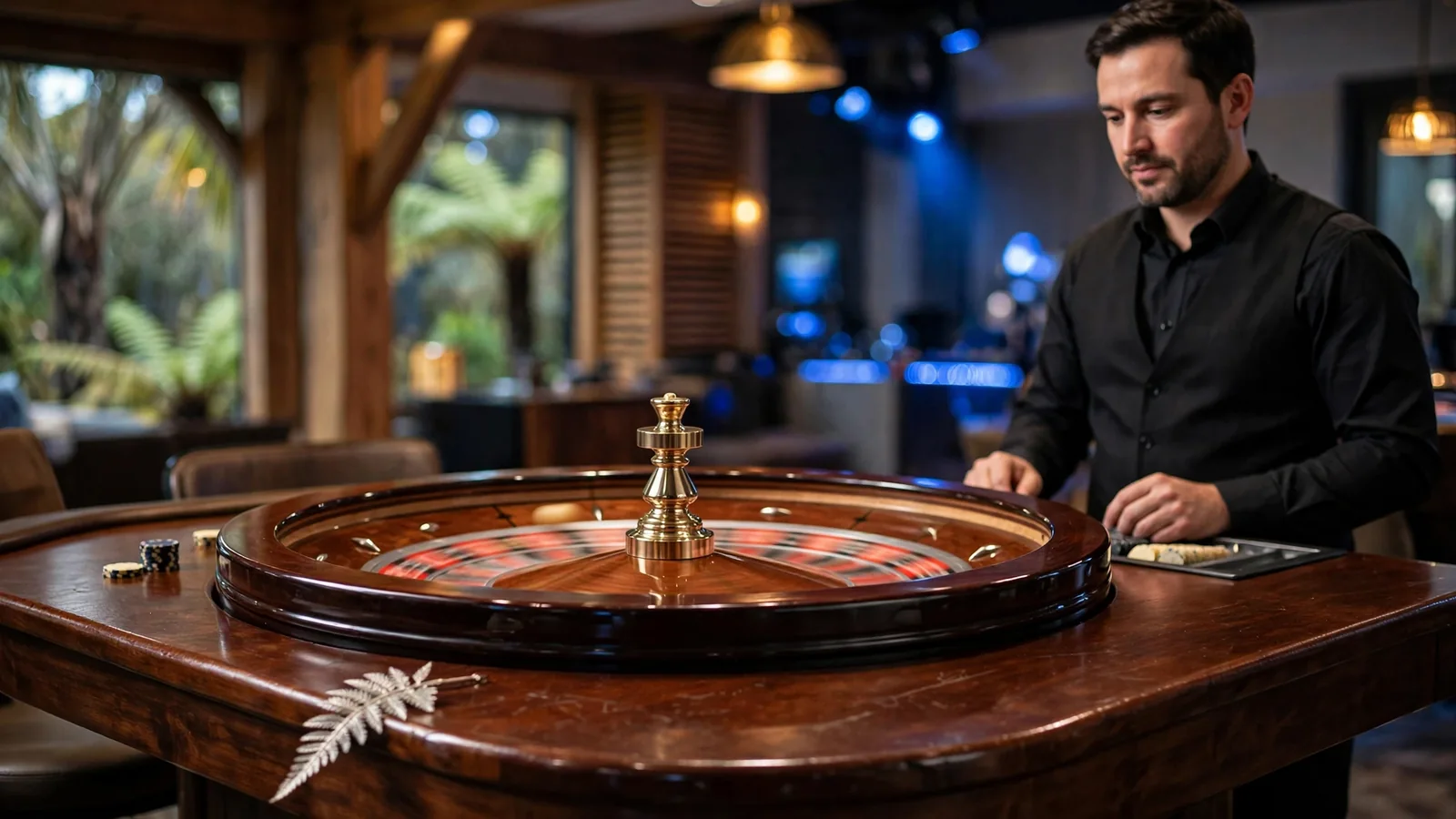
Live Dealer Blackjack in New Zealand: How It Works
 Available in US
A live stream shows a real dealer and physical cards, while table rules, betting conditions and the digital interface determine how play works.
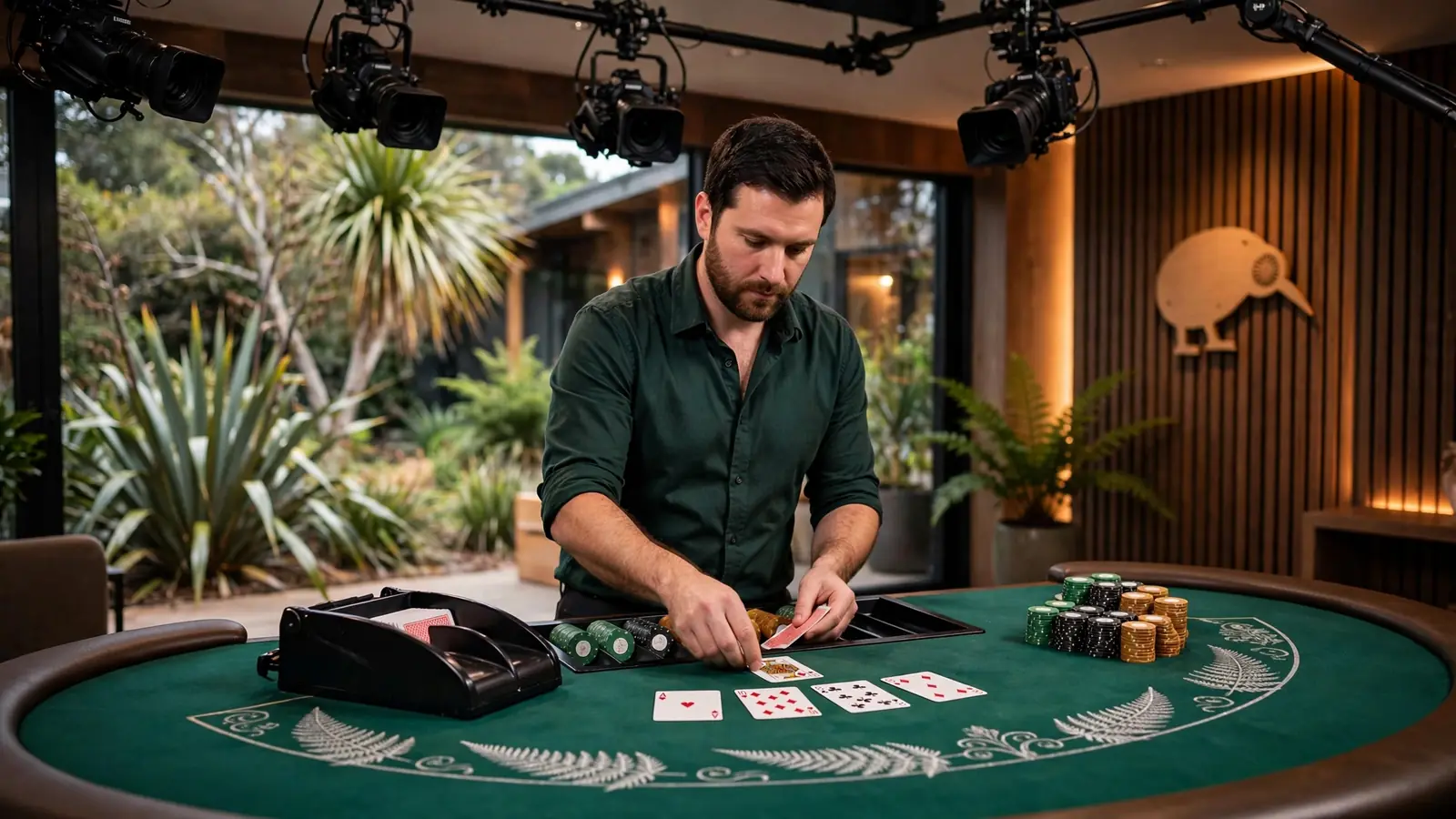
Table of Contents
- How Live Dealer Blackjack Works in 2026
- Choosing a Live Blackjack Table by Its Rules
- What to Check Before Using a Live Blackjack Site
- Playing Live Blackjack for Real Money: Read the Terms First
- Your First Live Blackjack Hand: The Basic Decisions
- The Dealer, the Cards and the Live Table
- Managing Your Money at a Live Blackjack Table
- Can You Practise Live Dealer Blackjack for Free?
- Blackjack Payouts, Variants and Insurance Bets
- What Changes When You Play Blackjack With a Live Dealer?
How Live Dealer Blackjack Works in 2026
Live dealer blackjack combines a streamed table with a real dealer handling physical cards. You watch the action through a video feed, while the game is presented online rather than across a casino table. The format brings the sight of actual cards and a human dealer into an online session, but it still depends on a stable stream and the table’s digital interface. A delay in the video can affect how promptly the game moves, and live tables may call for higher bets than other online options.
That distinction matters when you are deciding what “live” means. The dealer and cards are real; the stream is how you see the table from a distance. It is not the same as sitting in a casino, where you are physically present and can see the table directly. Nor does the live presentation tell you by itself how a particular game is run or what conditions apply. Those details belong to the table, not to the camera or the dealer’s presence.
Choosing a live dealer blackjack site in New Zealand means weighing the details you can verify before you play. This list gives you a concise reference to the available payout-speed and licensing information for each operator.
Payout speed: 1-3 business days Lamabet lists a payout speed of 1–3 business days, giving you a stated timeframe to consider.
License: 07017519840 · Payout speed: 1-3 business days Zotabet lists licence number 07017519840 and a payout speed of 1–3 business days, giving you both licensing and payout details to review.
Payout speed: 1-3 business days Wintino lists a payout speed of 1–3 business days, which gives you a stated timeframe to consider.
License: Tobique Gaming Commission, licence no. 0000002 Ricky Casino lists a Tobique Gaming Commission licence, number 0000002, for you to take into account.
License: Tobique Gaming Commission, licence no. 0000064 Neospin lists a Tobique Gaming Commission licence, number 0000064, for you to review.
License: Malta Gaming Authority, licence no. MGA/B2C/394/2017 N1 Casino lists a Malta Gaming Authority licence, number MGA/B2C/394/2017, giving you a specific licensing detail to check.
License: Curaçao Gaming Authority, licence no. OGL/2024/165/0185 BitStarz lists a Curaçao Gaming Authority licence, number OGL/2024/165/0185, for you to consider.
License: Tobique Gaming Commission, licence no. 0000091 7Bit Casino lists a Tobique Gaming Commission licence, number 0000091, which you can use as a reference point.
License: Malta Gaming Authority, licence no. MGA/B2C/370/2017 Play Grand lists a Malta Gaming Authority licence, number MGA/B2C/370/2017, giving you a specific licence detail to review.
In New Zealand, the context for online casino gambling is changing. The Online Casino Gambling Act 2026 came into force on 1 May 2026 and created the country’s first domestic licensing framework for online casino gaming. That is a significant change from the earlier position: online casino services offered from outside New Zealand had not been licensed or supervised by a New Zealand regulator. A customer who had a dispute with an offshore site during that period did not have domestic government recourse.
The new framework does not mean that every online casino became locally licensed as soon as the Act began. New Zealand has historically prohibited online casinos from being based in the country under the Gambling Act 2003. The 2026 law sets up a transition while the licensing system is introduced. Providers that were already offering services to people in New Zealand before 1 May may continue during that transition, subject to the Act’s transitional provisions, until 1 December 2026. The full licensed regime is not expected to be fully operational until 2027.
This transition is relevant whether the game is a live dealer table or another form of online casino gambling. The format does not determine an operator’s legal position. During the transition, providers are prohibited from advertising online casino gambling to people in New Zealand. If a provider has not applied for a licence by the end of the transition on 1 December 2026, it must stop conducting online casino gambling in the country. A provider whose application is declined must also cease those operations and leave the market. The Act’s framework anticipates that unlicensed operation will become an offence around mid-2027.

Regulatory responsibilities are divided. The Department of Internal Affairs is New Zealand’s primary gambling regulator and oversees the online casino licensing framework. The Gambling Commission hears and determines casino licensing applications. It is also responsible for issuing online casino licences and approving changes to licence conditions. These roles help explain why the shift is not simply a matter of an overseas casino displaying a licence from another jurisdiction: the 2026 Act establishes a domestic system, with local authorities responsible for its licensing decisions and oversight.
For you as a player, the practical point is to keep the live table and the regulatory setting separate in your mind. A streamed dealer does not, on its own, confirm that the service is authorised under New Zealand’s new framework. Equally, a transition period does not mean that the licensing regime is already fully in place. The change is being phased in, and the legal status of providers depends on the requirements and timing set by the Act.
A live dealer blackjack casino may look familiar because the dealer handles cards in real time, but the session remains an online service delivered through a stream. That can mean pauses, connection-related delays or table conditions that differ from an in-person casino. Those features describe the format; they do not establish the provider’s standing under New Zealand law. In 2026, both aspects matter: what you are watching at the table, and where the country’s licensing transition has reached.
Attention: A streamed dealer does not confirm that a service is authorised under New Zealand’s new framework, nor does a transition period mean the licensing regime is already fully in place.
Choosing a Live Blackjack Table by Its Rules
Two live blackjack tables can look similar while offering different conditions for play. Before settling on one, compare the rules shown for the table itself. The number of decks, the dealer’s action on soft 17, surrender availability and the payout for a natural blackjack can differ between games. Those details shape the game more than the table’s name or presentation.
Deck count and soft 17
Start with the deck count. A table may use a different number of decks from another, and that changes the mix of cards in play. Do not assume that every live table uses the same setup. If the number of decks is not stated in the rules, you cannot make a reliable comparison on that point.
Next, look for the rule on soft 17. A soft total includes an ace counted as 11 without taking the hand over 21; an ace can also count as 1. The rule tells you whether the dealer must take another card or stop when holding a soft 17. That distinction affects how the dealer’s hand develops, so it can change the decisions that make sense for you. Check the wording rather than inferring the rule from the table title.
These conditions should be considered together. Deck count alone does not tell you how favourable a table is, and the soft-17 rule is only one part of the ruleset. A table with a familiar label may still differ from another table in ways that matter.
Compare the complete rules, not one headline
Look for the full rule set, including whether surrender is permitted and what a natural blackjack pays. A natural blackjack is a two-card total of 21. Its payout is not guaranteed to be identical at every table. A specialist review has reported that some tables pay 3:2 while others pay 6:5; treat that as a reported difference, not as a promise about every live game. The table’s own rules are the relevant terms for the game you are considering.
Surrender rules also deserve attention. If the option exists, the rules should explain when it may be used. Do not assume it is available simply because you have seen it at another table. The same principle applies to other conditions: a game’s label does not establish its rules.
Blackjack variants can alter several rules at once. Those differences may affect both strategy and the house edge, so a familiar game name is not enough to establish that two tables are equivalent. If the details are unclear or the rules seem incomplete, avoid treating the table as a known quantity.
Make comparisons that mean something
When comparing live blackjack options, keep the comparison specific: deck count, dealer action on soft 17, surrender terms and natural-blackjack payout. A short list of these conditions is more useful than a general claim that one table is “better.” There is no single best table for every player; the rules determine what you are comparing, while your own preferences determine which differences matter to you.
Pay particular attention to rule combinations rather than looking for one supposedly decisive feature. A soft-17 rule may matter, but it does not erase differences in payouts or surrender availability. Likewise, a payout headline does not tell you whether the rest of the conditions suit you. Treat each table as its own ruleset.
- Compare specific deck counts
- Check the dealer’s action on soft 17
- Verify the natural blackjack payout
- Review surrender availability
- Rely on the table’s name
- Assume all live tables use the same setup
- Infer rules from a headline
- Treat a familiar game label as a guarantee
If you are interested in card counting, distinguish the legal question from whether a method can help in a particular game. Mental card counting is not illegal under New Zealand law. That fact does not establish that counting will be effective or that a table’s rules make it worthwhile. Do not mistake a live format for a guarantee about the conditions or likely outcome.
A concern about a dealer or a disputed hand is also separate from comparing rules. The rules tell you what the table says should happen; they do not, by themselves, establish why a particular result occurred. Keep the question focused on what is written for that game, rather than assuming that an unfavourable outcome proves misconduct.
Ultimately, choose by the conditions you can actually identify. If one table clearly states its deck setup, soft-17 rule, surrender terms and payout, while another leaves those points unclear, the first gives you a firmer basis for comparison. That does not make it a guaranteed better choice; it means you know more about the game you would be joining.
What to Check Before Using a Live Blackjack Site
Before opening a live blackjack table, check what applies to the particular game and to the service offering it. A polished page or a mobile-friendly layout cannot tell you whether the rules suit you, whether the table is available where you are, or what conditions attach to an account or promotion.

Start with the table information. Check the number of decks, whether the dealer hits or stands on soft 17, whether surrender is allowed, and what payout applies to a natural blackjack. These details can differ from one game to another. A specialist review also notes that these rules and payouts vary between tables, so do not assume a setting described in a general overview applies to the table you have selected. If a rule is unclear, look for the table’s own rules panel or help page before joining.
Check that the rules are accessible on the device you intend to use. On a phone, make sure the full table information is readable and that you can reach it without losing your place in the game. A mobile version should make the same key conditions visible as the desktop version; a compact screen is not a reason to proceed without confirming them. If you are considering a lower-stakes table, check the displayed minimum and maximum bets directly rather than relying on a general description of the site.
Also look for clear, consistent information about who provides the service and how it operates. New Zealand’s online casino rules are in transition. The Online Casino Gambling Act 2026 took effect on 1 May 2026, creating a domestic licensing framework, but the full regime is not expected to be operating until 2027. Providers that were already serving New Zealand customers before the Act began may continue during the transition, which ends on 1 December 2026. This means a site’s presence during the transition should not be mistaken for confirmation that it holds a New Zealand online casino licence.
Check Before Joining
- Confirm the number of decks and soft 17 rule
- Verify the natural blackjack payout and surrender terms
- Ensure table information is readable on your device
- Check the displayed minimum and maximum bets
- Review the provider’s regulatory standing and identity checks
The Department of Internal Affairs is New Zealand’s primary gambling regulator and oversees the online casino licensing framework. The Gambling Commission handles casino licensing applications and decisions, including approval of changes to licence conditions. Use those official sources to understand the regulatory position rather than treating a badge or a site’s own description as proof of local licensing. Before the domestic regime is fully operational, online casino gambling from outside New Zealand was not supervised or licensed by a New Zealand regulator, and customers had no domestic government recourse.
If you see a welcome offer or a no-deposit promotion alongside a live table, read its conditions before relying on it. Check whether blackjack is included and whether it is treated differently from other games; also look for any maximum-bet rule that applies while meeting wagering requirements. A headline offer does not establish that a particular table qualifies. Keep this check separate from the table’s playing rules: the conditions for an offer may apply across the account, not just to blackjack.
Finally, check that the site explains its age and identity checks and gives you a clear way to find support information. A service that leaves basic rules, account conditions or regulatory details difficult to locate is asking you to proceed without a useful picture of what you are agreeing to. Take time to verify those details before registering or depositing.
Playing Live Blackjack for Real Money: Read the Terms First
When you play live blackjack for real money, the table rules are only part of the decision. The terms attached to deposits, bonuses and withdrawals can affect what you can do with your balance. Read those conditions before accepting an offer or placing a bet, and make sure you understand which rules apply to your account.
A bonus can come with wagering requirements: conditions that must be met before bonus-related funds or winnings can be withdrawn. Do not assume that blackjack counts towards those requirements in the same way as other games. The contribution may differ, so check the wording for blackjack specifically. If the terms are unclear, treat that uncertainty as a reason to pause rather than relying on an assumption.
Also look for any maximum-bet rule that applies while you are meeting wagering requirements. A table may let you place a bet, while the bonus conditions place a separate restriction on betting during that period. Check whether the rule applies to live blackjack and whether accepting the bonus changes the conditions under which you play. A restriction that you notice only after playing can complicate a later withdrawal.
Read the bonus conditions alongside the general terms, not as a headline offer in isolation. Check whether the offer is optional, what actions count towards its requirements, and what happens if you decline or cancel it. Confirm how the site describes eligible games and whether the conditions distinguish live-dealer blackjack from other blackjack games. The exact wording matters more than broad claims about an offer.
Keep your own funds and any bonus balance clear in your mind. Before you start, establish which balance is being used and whether the offer brings conditions you do not want. If you prefer to play without a bonus, check that you have not opted into one inadvertently. Do not treat a bonus as extra money you can freely withdraw; its terms determine how it may be used.
Bonus wagering requirements may treat blackjack differently from other games, and separate maximum-bet rules may apply while these requirements are being met.
The payment terms deserve the same attention. Read how deposits and withdrawals are handled, what checks may be required, and whether any conditions apply before a withdrawal can be processed. Avoid relying on promotional language where the full terms set out the actual conditions. Save or note the terms that apply when you opt in, so you can refer back to them if the account page or offer changes.
Real-money play should fit within a budget you have already decided on. A bonus does not make a loss affordable, and wagering requirements are not a reason to keep playing after you have reached your limit. If the financial conditions are difficult to understand, or you would need to spend more than planned to meet them, declining the offer is a straightforward choice.
Your First Live Blackjack Hand: The Basic Decisions
Blackjack is a contest against the dealer. Your aim is to make a hand closer to 21 than the dealer’s without going over. You do not need to reach 21: a lower total can still win if the dealer finishes with less, while a hand that exceeds 21 is bust.
Number cards count at their face value, and each king, queen or jack counts as 10. An ace can be worth either 1 or 11, whichever gives your hand the more useful total without busting. For instance, an ace with a six can count as 7 or 17. If another card would take the total beyond 21, the ace can count as 1 instead.
Once your initial cards have been dealt, you choose how to continue. The available choices depend on the situation and the table’s rules, so take a moment to understand the controls before you act.
Hit or stand
Choose hit to take another card. This may improve a low total, but it can also push your hand over 21. With an ace in your hand, the total may be flexible because the ace can change from 11 to 1 if needed.
Choose stand when you want to keep your current total and take no more cards. The dealer then completes the dealer’s hand according to the game rules, and the two totals are compared. A higher total does not help if it is over 21, so the aim is not simply to keep taking cards until you get as close as possible.
Double down
Double down is a choice to increase your stake in return for receiving one more card and then ending your turn. It can be a useful option in some situations, but it leaves no opportunity to hit again if that card does not help. Whether you can double down, and when, depends on the table rules.
Split a pair
If your first two cards have the same value, you may be allowed to split them. This separates the pair into two hands, with each hand played in turn. Splitting changes how the hand continues and may require an additional stake, so check the action and its terms before confirming. Rules about which pairs can be split can differ.
The decision buttons do not replace the game’s rules: they put those rules into action. Before you choose, check what each option will do to your hand and stake, and whether that choice is available in the current situation. If you are uncertain, pause rather than clicking quickly. A clear understanding of hit, stand, double down and split makes it easier to follow each hand and see how its result is determined.
Basic Hand Decisions
Decide whether to hit to improve a low total or stand to keep your current hand.
Increase your stake for one final card if the situation is favourable.
If your first two cards have the same value, decide whether to split them into two separate hands.
The Dealer, the Cards and the Live Table
At a live blackjack table, the cards are physical rather than generated by software. A dealer handles them at a casino table, while a camera feed lets you follow the game remotely. That visible dealing is the defining difference: you are watching a real table in progress, not a digital animation of one.
The stream also shapes the experience. A card has to be dealt, the table action has to be shown, and the game may pause while the feed catches up. Streaming can therefore introduce delays that are not part of a software game. If you are used to clicking through hands quickly, the live format may feel slower. A pause does not necessarily mean anything has gone wrong; it may simply be part of the streamed process.
A delay can still matter when you are deciding whether the table suits you. The pace is set by the live game and its feed, rather than only by how quickly you make a choice. Give yourself time to follow what is happening, and avoid treating a slow moment as a reason to make a rushed decision. If the stream is unclear or appears to have stopped, pause and check the table’s on-screen information before continuing.
The betting conditions can differ from those of other blackjack games, and live tables may require higher bets. Check the displayed terms before joining, so you know whether the table’s conditions fit your plans. The physical cards and streamed presentation do not, by themselves, tell you what those conditions are.
You may also wonder whether a live blackjack dealer can hear you. A video stream alone does not establish whether audio is sent back to the table. Do not assume that speaking to your screen reaches the dealer; check the table interface and its information about communication. If there is no clear indication of a two-way audio feature, treat the feed as something to watch rather than a conversation.
The camera view can make the cards and dealer easier to follow than a software animation, but it does not remove the need to pay attention to the display. Streaming quality and timing affect what you see, while the actual cards are dealt at the table. Keep the distinction in mind: the game is live, but your view of it depends on the stream.
Managing Your Money at a Live Blackjack Table
Before opening a real-money live blackjack table, decide what you can afford to lose and treat that amount as the cost of entertainment. Keep it separate from money needed for bills, food, savings or other commitments. A budget is useful only if it is a firm boundary: once the money you set aside is gone, stop playing rather than adding more to recover it.
It can help to choose a stopping point before you begin, while you are calm. That might be a spending limit, a time to leave the table, or both. Avoid changing that plan in response to a run of wins or losses. A win does not make further spending risk-free, and a loss does not create an obligation to keep playing until you get the money back.
Budget Risk
Avoid chasing losses by raising bets or depositing more money; once your set limit is gone, you should stop playing.
Chasing losses is especially tempting when you are focused on the table and want to undo what has happened. Raising your bets or depositing again can make the amount at risk grow quickly, without making a recovery more certain. If you notice yourself bargaining with your own limit, take that as a reason to stop for the session. Step away from the screen before deciding whether to play again.
Make the budget practical. Use only money you have already set aside for leisure, and do not borrow or use credit to extend a session. Keep track of what you have spent rather than relying on memory, particularly if you move between tables or take breaks. If the site offers account tools that help you restrict access or spending, read how they work before relying on them; the limit you set for yourself should still be clear.
Promotions can complicate the picture. A bonus may come with wagering requirements, and blackjack may count differently from other games. Maximum-bet rules can also apply while those requirements are in force. Read the conditions before accepting an offer, and do not treat bonus funds as a reason to spend beyond your planned budget. The terms may affect what you can withdraw, but they do not change the risk of losing money during play.
A live dealer can make a session feel more involving, but the format does not give you a reason to revise your spending boundary. If the experience stops feeling like entertainment, or you find yourself trying to win back money, end the session. Keeping the decision to stop separate from the outcome of the last hand is a useful safeguard when playing blackjack for real money.

Can You Practise Live Dealer Blackjack for Free?
Free practice and a live-dealer game are not necessarily the same experience. A free version may use software to deal and shuffle cards, while live dealer blackjack uses actual cards at a streamed table. If a live table offers a free-play option, check that it is genuinely the live stream rather than a separate software game: the distinction affects the pace and feel of a hand.
Software-based RNG blackjack can move faster because the game does not need to wait for a dealer to handle cards or for a stream to reach you. That can make it useful for getting familiar with the flow of play, but it does not reproduce the pauses and timing of a live table. A streamed game may take longer between decisions, and transmission delays can add to that wait.
If you are looking for free live dealer blackjack, treat “free” as a description to verify, not a guarantee that every table has a practice option. Read the table information before joining. Confirm whether you are watching a real dealer and physical cards, or playing a software simulation. The screen can look similar while the format is different.
The question of whether live dealer blackjack is rigged cannot be answered from the pace alone. A live game involves actual cards dealt at a table and shown through a stream; an RNG game uses software shuffles. Those are different formats, and neither a faster sequence nor a delayed stream is, by itself, proof that the cards have been manipulated. A stream delay may make the experience feel less immediate, but it does not establish what happened to the cards.
Can you practise live dealer blackjack for free?
Yes, if the table offers a free-play option, though you should verify if it is a genuine live stream or a software simulation.
Is live dealer blackjack rigged because of stream delays?
No, a stream delay is a technical part of the broadcasting process and is not proof that the physical cards have been manipulated.
Does a software RNG game feel the same as a live table?
No, software games move faster and lack the physical dealing pauses and transmission delays inherent in a streamed live game.
Use free practice to learn the interface and become comfortable following a game, not as evidence that a live table will behave identically. Software play may let you see more hands in less time, while a live stream has the pauses inherent in dealing and broadcasting. If your aim is to understand the live format, a software game can provide practice with blackjack, but it cannot reproduce the streamed table itself.
Blackjack Payouts, Variants and Insurance Bets
A natural blackjack payout can change the value of a hand, so read the paytable rather than assuming every live table treats it alike. One specialist review reports that some tables pay 3:2 for a natural blackjack while others pay 6:5. That difference applies to the payout, not to the cards you were dealt; check the table’s stated rule before choosing where to play.
The name of a variant is not enough to tell you how it works. Rules can differ between blackjack versions, and those differences may affect both the decisions available to you and the house edge. Depending on the table, surrender may be allowed, while other rules can change how a hand is played. A free-bet version, for instance, should be assessed by its written rules and payout terms, not by the label alone. The same care applies when comparing live dealer blackjack games: familiar names do not guarantee identical conditions.
Insurance deserves particular caution. It is an additional wager offered in a specific situation, not a routine part of every hand. Before accepting it, check exactly what the table pays and how the bet is settled. Avoid treating insurance as a dependable way to protect your main wager; for most players, it is not a bet to make automatically. If the terms are unclear, decline it rather than relying on an assumption about how it works.

When comparing tables, keep the headline payout separate from the less visible rules. A table may look appealing because of its natural-blackjack payout, but another rule may change the overall conditions. Compare the complete rules together, including available actions, rather than judging a game by one feature. The best live dealer blackjack option for you is the one whose payout and variant rules you understand before you sit down—not simply the one with the most attractive-sounding label.
What Changes When You Play Blackjack With a Live Dealer?
The clearest difference is the pace. Software-based blackjack uses shuffled digital cards, so the game can move quickly from one round to the next. At a live table, a dealer handles actual cards and the action is streamed to your screen. That gives the game a more table-like feel, but each round can take longer.
The stream also affects how play feels. You watch the dealer and cards as events unfold, rather than seeing a software animation resolve the hand. If the connection or broadcast introduces a delay, you may have to wait before the next part of the game appears. That can make a live table feel less immediate than an RNG game, even when you are following the same basic blackjack format.
There can be a practical difference in the stakes, too: live tables may require higher bets than software games. So the format is not only a choice about atmosphere or speed. It can also shape whether the table suits the amount you are comfortable putting into play.
Neither format is automatically better. Software blackjack tends to suit players who want quicker rounds; a live dealer may suit those who prefer watching real cards dealt in a streamed casino setting. The useful distinction is what you value more: a faster, software-run game or the slower, more human rhythm of a dealer-led table. The experience can vary with the stream, so it is worth recognising that live play may involve pauses as well as a different pace.
Created by the ”Casino Payment Info NZ” editorial team.