
Best Pokies Sites in New Zealand: What to Check
 Available in US
Understand how operator identity, game information and New Zealand’s legal framework shape a careful comparison of online pokie sites.

Table of Contents
- What “Pokie Sites” Means for New Zealand Players
- How New Zealand’s Online Casino Rules Are Changing in 2026
- Pokie Websites and Sister Sites: Check the Operator Behind the Brand
- Playing Pokies Online: What the Spin Can—and Cannot—Tell You
- Casino Sister Sites and Pokie Spins: Understand the Game Before You Play
- RTP and Volatility: Why No Pokie Site Can Promise a Win
- New Pokie Sites in 2026: Treat a New Licence as Something to Verify
- Free Pokies Sites: Know What the Available Information Can Confirm
- Real-Money Pokies: Legal Status and Tax Basics
- What Makes a Pokie Site “Top” Is Not a Promise of Better Results
What “Pokie Sites” Means for New Zealand Players
A pokie site is an online casino where you can play pokies through a website or app. The phrase describes a type of service, not a particular operator. It can refer to a casino with a broad game lobby or to one where pokies are the main attraction.
That distinction matters when you are comparing options. A list of sites might rank operators, while a discussion of pokie sites can explain what the term covers and how online play fits New Zealand’s rules. A ranking is a starting point for comparison, not a prediction of what you will experience.
You may also see people use “pokie website” and “online casino” interchangeably. In practice, the latter can offer other casino games as well as pokies; the former often reflects what a player came to find. Neither label, by itself, tells you who runs the business or where it is based. Those details matter because New Zealand law draws a line between operating an online casino from within the country and a person in New Zealand choosing to play at a casino based offshore.
Choosing a pokies site is easier when you can check the details that matter to you before you play. This list gives you a concise starting point for reviewing options available to New Zealand readers.
Payout speed: 1-3 business days Lamabet lists payouts as taking 1–3 business days. Check whether that timeframe suits you before choosing the site.
License: 07017519840 · Payout speed: 1-3 business days Zotabet lists licence number 07017519840 and a payout speed of 1–3 business days. These details give you specific points to consider when reviewing the site.
Payout speed: 1-3 business days Wintino lists payouts as taking 1–3 business days. You can use that information when considering the site.
License: Tobique Gaming Commission, licence no. 0000002 Ricky Casino lists a licence from the Tobique Gaming Commission, licence no. 0000002. You can consider this licensing detail when reviewing the operator.
License: Tobique Gaming Commission, licence no. 0000064 Neospin lists a Tobique Gaming Commission licence, no. 0000064. This is a specific licensing detail for you to check.
License: Malta Gaming Authority, licence no. MGA/B2C/394/2017 N1 Casino lists a Malta Gaming Authority licence, no. MGA/B2C/394/2017. You can use this detail as part of your review.
License: Curaçao Gaming Authority, licence no. OGL/2024/165/0185 BitStarz lists a Curaçao Gaming Authority licence, no. OGL/2024/165/0185. You can take this licensing information into account when assessing the site.
License: Tobique Gaming Commission, licence no. 0000091 7Bit Casino lists a Tobique Gaming Commission licence, no. 0000091. This gives you a concrete licensing detail to consider.
License: Malta Gaming Authority, licence no. MGA/B2C/370/2017 Play Grand lists a Malta Gaming Authority licence, no. MGA/B2C/370/2017. You can use the listed licence as one point of reference when reviewing the operator.
Under the Gambling Act 2003, an online casino cannot lawfully be run from inside New Zealand. The restriction concerns the operator’s activity here. It does not make an individual player’s decision to use an offshore casino a criminal offence. New Zealanders may play at offshore online casinos, even though the business providing the service is not a locally operated casino.
This difference can be easy to miss when a site is available in New Zealand. Being able to open a website or create an account does not mean the casino is based here. Equally, an offshore operator serving players in New Zealand is not the same thing as a casino operating from within the country. The location and role of the operator are central to the distinction; the wording on a homepage is not enough to establish them.
So when you are looking at a new pokie site, keep the terms separate. “New” may describe a recently launched website or a brand you have only just encountered. It does not, on its own, explain where the operator is established or whether the site is a domestic business. The same applies to familiar-looking branding: a polished design or a New Zealand-facing page does not change the basic distinction between playing offshore and running an online casino from within New Zealand.
What makes a site appropriate for you depends on details beyond the category name. A site can offer pokies without being a New Zealand-based casino, and a player can access an offshore casino without thereby operating one.
There is no need to treat the legal distinction as a reason to assume that every offshore site is alike. The point is narrower: New Zealand law treats the act of operating an online casino within the country differently from an individual playing at a casino based overseas. If you are browsing, first be clear about which side of that line you are considering. You are a customer choosing where to play; you are not the business running the casino.
That framing helps make sense of labels such as “pokie site,” “online casino” and “new pokies site” without confusing a type of website with its operator or location. The name tells you what kind of entertainment is being offered. It does not, by itself, answer who is behind the service or where it is run.

How New Zealand’s Online Casino Rules Are Changing in 2026
New Zealand’s online casino framework is moving from a period without domestic licensing of offshore services towards a system that will authorise and supervise providers. The Online Casino Gambling Act 2026 came into force on 1 May 2026, establishing the country’s first domestic licensing regime for online casino gambling. That does not mean the full system is already operating: the transition has its own rules, and the complete licensed regime is not expected to be fully operational until 2027.
The Department of Internal Affairs (DIA) is identified as the regulator under the licensing framework. Its role is therefore central to how the new system is put into practice: licensing is intended to determine which providers may operate under New Zealand’s rules, while ongoing oversight concerns whether those providers continue to meet them. The change is not simply a new label for casino websites. It creates a domestic regulatory structure where there was previously no New Zealand licensing or supervision of online casino gambling supplied from overseas.
The Online Casino Gambling Act 2026 established New Zealand’s first domestic licensing regime, with the Department of Internal Affairs (DIA) serving as the regulator.
A staged change, not an instant switch
The Act provides for a transitional period running from 1 May to 1 December 2026. Online casinos that were already providing services to people in New Zealand before the Act came into force may continue doing so during that period, subject to the transitional provisions. This is a temporary arrangement, not confirmation that every site available to New Zealand players has been licensed or approved.
A specialist review describes the licensing rollout as expected to be in place from 2026. That timing needs to be read alongside the Act’s transition and the expectation that the full regime will not be operational until 2027. In practical terms, 2026 is a year of change rather than a point at which every part of the licensing system should be assumed to be active. A site’s availability during the transition, by itself, does not establish that it holds a New Zealand licence.
The framework also changes the consequences for operators over time. New Zealand does not permit online casinos to be based within the country. Under the Act, unlicensed operation is expected to become an offence from around mid-2027. That is an operator-side rule; it should not be confused with a claim that an individual player commits an offence simply by playing at an offshore platform.
How many licences are envisaged?
A specialist review of the proposed framework reports that it initially provides for up to 15 licences. That figure describes the framework’s initial limit, not the number of licences already issued or the number of operators that will necessarily receive one. The actual position depends on the licensing process and its implementation. Until licensing decisions are made, a site should not be treated as authorised merely because it is operating or says it intends to apply.

A capped licensing system could make the distinction between a casino’s marketing and its regulatory status especially important. A brand may describe its plans confidently, but plans are not the same as a licence. The relevant question will be whether the operator has been granted authorisation under the New Zealand framework, and whether that authorisation applies to the service being offered to you.
What licensed operators will have to meet
The requirements described for licensed operators cover several areas, rather than licensing being a one-time formality. A specialist review summarises them as including harm minimisation, restrictions on advertising, age verification and tax contributions. These obligations are intended to shape how a licensed service is run, how it communicates with customers and how it responds to risks associated with gambling.
Age verification is one concrete part of that picture: online casino play in New Zealand is restricted to adults aged 18 and over. Harm-minimisation requirements are also relevant to the way operators manage gambling-related risks. Advertising restrictions set boundaries on how licensed services may promote themselves, while tax contributions form part of the obligations attached to operating under the system.
For you, these standards matter because a New Zealand licence is meant to signal that an operator falls within the domestic framework and its conditions. They do not promise that you will win, prevent every dispute or remove the need to make careful decisions. Nor should general statements about regulation be taken as proof that a particular website is licensed. The new system is being implemented in stages, so claims about New Zealand approval need to be distinguished from evidence of an actual licence.
Licensing Framework 2026
- The full licensed regime is not expected to be fully operational until 2027.
- A transitional period exists from 1 May to 1 December 2026 for existing providers.
- The framework initially provides for a cap of up to 15 licences.
- Licensed operators must meet standards for harm minimisation, age verification, and tax contributions.
As 2026 progresses, the key change is the creation of a route to domestic authorisation and oversight, with transitional arrangements before the full regime is expected to operate. The framework sets out a limited initial number of licences and obligations for those who obtain them. Until the licensing system is fully in place, the date of the reform alone cannot tell you which individual sites have been authorised.
Pokie Websites and Sister Sites: Check the Operator Behind the Brand
A familiar name, matching design or shared games can make two casino websites look connected. That does not tell you who runs them, whether they have the same legal owner or whether a licence covering one brand also applies to the other. When you assess an online pokies website, look past the brand and identify the operator named in its terms and conditions.
The operator is the legal entity responsible for providing the service. Its name may appear in the footer, account terms, privacy notice or responsible gambling information. Check that the details are consistent across those pages. If a website describes itself as part of a group, that description is not a substitute for finding the entity responsible for your account.
What a connection between brands does—and does not—show
People looking for Pokie Island sister sites may encounter pages or promotional material that group casino brands together. Treat such groupings as a starting point for checking, not proof that the sites share an owner, licence or customer service team. Similar branding can be suggestive, but it cannot establish the legal relationship.

If two brands are operated by the same company, some terms may be shared. But do not assume that an account, balance, complaint route or licence status automatically carries across from one site to another. Read the terms for each website you use and check which entity is named there. If the operator is unclear, or the information conflicts between pages, pause before creating an account or depositing.
A useful check is to compare the operator name in the site’s legal terms with the name shown in its licensing information. Then confirm that the licence issuer’s own records identify that operator and cover the brand you are considering. A logo or badge on a website is not, by itself, confirmation. Licences belong to particular entities and may have conditions; a claim about one brand should not be treated as evidence about another.
New Zealand residents can legally play at internationally licensed sites. That does not mean those sites are licensed or supervised by a New Zealand authority. For an offshore casino, the licensing information relates to the jurisdiction named by the operator, so verify the details with the relevant issuer rather than assuming a local approval exists.
Why the operator matters in a dispute
The operator’s identity becomes especially important if something goes wrong. Offshore casino websites are not overseen by the Department of Internal Affairs, and New Zealand has no local consumer protection agency that can resolve a player’s dispute with one of them. You may therefore have to raise a complaint through the operator’s own process or the relevant overseas route, if one is available.
New Zealand has no local consumer protection agency that can resolve a player’s dispute with an offshore casino.
Before you rely on a site’s support channel, find out how complaints are meant to be submitted and which company handles them. Save the terms that apply when you register, along with relevant messages and transaction records. These steps cannot guarantee a particular outcome, but they can help you establish which business you dealt with and what it said its process was.
Be cautious if a website makes it difficult to identify the company behind it, gives no clear licensing information, or uses different legal names in different places without explaining the relationship. A polished site or responsive chat service does not answer those questions. Nor does a claim that several brands belong to one group establish that every brand has the same protections.
A practical check before you proceed
Read the legal footer and account terms, note the operator’s full name, and look for the stated licence and issuer. Check the licence with that issuer and make sure the details relate to the specific brand, not simply to a company name that appears somewhere on the site. If another casino is presented as a sister site, repeat the check for that website rather than carrying over assumptions.
This is not a way to remove every risk from offshore play. It is a way to avoid confusing a brand with the business accountable for it. When the operator or licence cannot be established clearly, you have less certainty about whom to contact and what process applies if a disagreement arises.
Playing Pokies Online: What the Spin Can—and Cannot—Tell You
When you play online pokies, each spin is generated at random. The result of an earlier spin does not influence the next one, even if you have seen a run of wins, a long stretch without a payout, or the same symbols appearing repeatedly. A sequence can look meaningful without offering a reliable clue about what comes next.
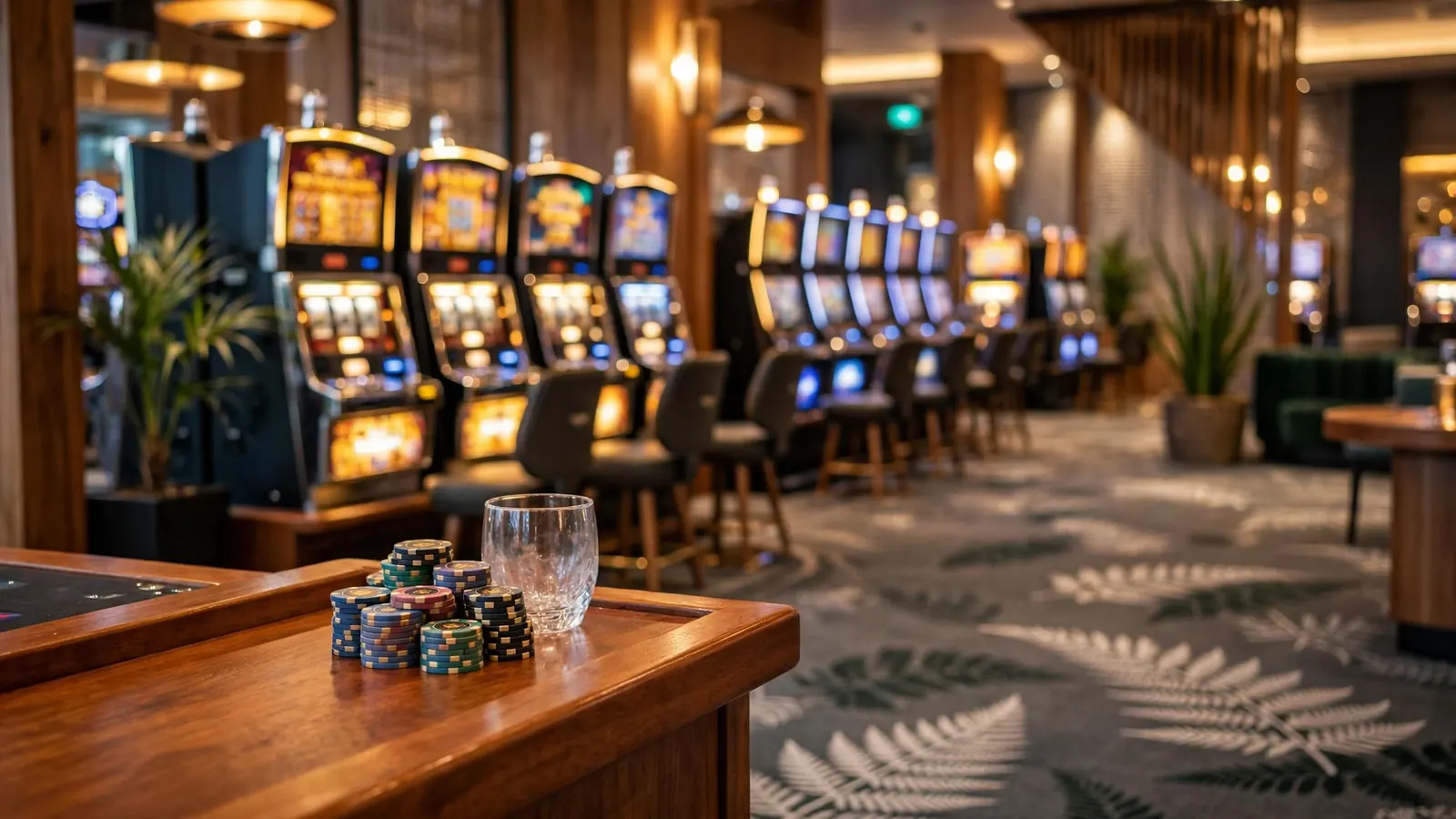
That matters when you are comparing pokie sites online or looking for the best online pokie sites in New Zealand. A run of recent results cannot tell you that a game is “due”, and a winning streak cannot show that another win is more likely. The previous outcomes may be part of the game’s history, but they do not form a signal you can use to forecast the next spin.
Why patterns can feel persuasive
People naturally look for patterns in sequences. If the same symbol appears several times, or a near miss follows a near miss, it can feel as though the game is building towards a particular result. That impression is understandable, but it does not change the randomness of the next spin.
A near miss is not evidence that a win is closer. Nor does a losing sequence mean the game must soon pay out to balance things. Random results can form short runs that look unusually orderly or frustrating; the appearance of a pattern is not the same as a prediction.
The same caution applies when a game displays previous results or a history of spins. These records can tell you what has already happened. They cannot establish what the next outcome will be. If you use them to decide when to increase a stake or keep playing, you are treating past results as information they do not provide.
What a spin can tell you
A completed spin tells you its own result: whether it produced a payout and what appeared on the reels. It does not reveal a schedule for future wins, show that a game is warming up, or indicate that a particular symbol is more likely to appear next.
Each spin is generated at random; previous results, including winning streaks or near misses, do not influence the outcome of the next spin.
This distinction can be easy to lose when a game’s graphics make each spin feel connected to the last. Animations, sounds and on-screen sequences can make an outcome feel like part of a developing story. The visual presentation may be engaging, but it does not turn previous results into a forecast.
If you are choosing among the best online pokie sites, a site’s presentation or a game’s recent results cannot establish that you will have better luck there. A string of favourable outcomes is not proof that the next spin will also be favourable; a string of poor ones is not proof that a win is imminent. No particular site can make randomness predictable.
Keep decisions separate from streaks
It helps to decide in advance how much time and money you are prepared to spend, then avoid changing that plan because of a streak. A win does not make the next spin safer, and a loss does not create a reason to chase it. Each new result remains uncertain.
Treat a spin history as a record, not a strategy. You can observe what happened without assuming that it gives you an edge. Once you separate the last result from the next one, it becomes easier to make choices based on your own limits rather than on a pattern that cannot predict the outcome.
Casino Sister Sites and Pokie Spins: Understand the Game Before You Play
Moving between casino brands or trying a different game can change the feel of a session, even when the basic action is still a spin. A familiar title may be easier to follow than a new one, but its features and pay structure still deserve a look. The label “sister site” does not tell you what a game does, and it does not mean that every pokie on one site will behave like a title on another.
Start with the format. Classic pokies use three reels and have no bonus rounds. Their simpler layout can make it easier to see the symbols and understand what a spin has produced. That simplicity does not make each result predictable; it only means there are fewer feature types to keep track of.
Video pokies commonly use five reels and may include wilds, scatters and free-spins rounds. Wild symbols can substitute for other symbols in some games, while scatters may trigger a feature. The rules vary by title, so check the game’s information panel before you play rather than assuming that a familiar symbol works the same way everywhere. Free spins add another stage to the game, but they do not change the basic point that each spin is a separate play.
Progressive jackpot pokies work differently again. Contributions from spins across casinos running the same game feed a shared jackpot pool. That shared pool can make the jackpot prominent, but part of each bet goes towards it. As a result, the base-game RTP on a progressive jackpot pokie is lower than it would be without that contribution. The jackpot feature is therefore part of the game’s design, not an extra promise attached to every spin.
Three reels with a simple layout and no bonus rounds.
Five reels featuring wilds, scatters, and free-spins rounds.
Shared jackpot pools funded by contributions from spins across multiple casinos.
When comparing titles across casino brands, look beyond the artwork and the name. Check whether the game is a classic, video or progressive jackpot pokie, and read its feature descriptions. Two games can look similar while offering different reel layouts or bonus mechanics. Even when you recognise a title, confirm the version and settings shown in the game itself.
That small pause matters when switching between games: a feature that is optional in one title may be central to another, and a jackpot contribution affects how its base game is structured. Knowing the format will not tell you what the next spin will do. It can help you understand what you are choosing to play, what features may appear, and where the jackpot sits within the game.
RTP and Volatility: Why No Pokie Site Can Promise a Win
A pokie’s return to player, or RTP, describes the share of all stakes the game is designed to pay back across a very large number of spins. It is a long-run statistical measure, not a forecast for your next session. Even a game with a high RTP can leave you with less than you staked, while a short session may produce a different result from the theoretical average.
That is why claims about the best pokie sites for winning need careful reading. RTP belongs to a game’s design, not to a promise from a website that you will come out ahead. It cannot tell you whether you will win on a particular spin, how long a run of losses might last, or when a payout will arrive.
Volatility describes the pattern of wins rather than the long-term return. Low-volatility pokies tend to produce smaller wins more often. High-volatility games pay less frequently, but a win can be larger. Neither pattern removes uncertainty: frequent small payouts can still leave your total stakes unrecovered, and a possible larger payout is not a likely or guaranteed outcome.
Your experience depends on the individual spins you get, not on a theoretical average being reached during your visit. RTP and volatility can help you understand how a game is designed to behave over time, but they cannot identify a site or game that will make you win. A site’s marketing language should not turn those measures into a claim about your personal result.
If you are comparing games, treat these figures as descriptions, not predictions. Decide what you can afford to lose before you start, and stop when you reach that limit. A session that ends without a win is still possible with any RTP or volatility profile; no figure can promise otherwise.
New Pokie Sites in 2026: Treat a New Licence as Something to Verify
A newly launched pokie site can look established before its regulatory position is clear. In New Zealand, the licensing transition makes that distinction especially important: a launch date or claim of being “new for 2026” does not, by itself, show that the operator holds a local licence.
A specialist gambling review describes the licensing rollout as expected from 2026, with the framework initially allowing up to 15 licences. Treat those details as a description of the anticipated regime, not proof that a particular site has been approved. The relevant question is whether the operator itself can demonstrate a valid licence under the rules that apply at the time you visit.
- Verify the legal entity running the site
- Check the licence with the official issuer
- Look for current information on operator status
- Trust a brand name alone as proof of licence
- Assume a polished design equals oversight
- Rely on general references to regulatory standards
The framework is intended to place specific duties on licensed operators. These include measures to minimise gambling harm, restrictions on advertising, age checks and tax contributions. A site that refers to these standards in general terms is not thereby showing that it meets them. Look for clear, current information identifying the operator and its licensing status, rather than relying on a new brand name, polished design or promotional language.
The transition also means that “new” can be an imprecise label. A new website or brand may not be the same thing as a newly licensed operator. Before treating a licence claim as meaningful, confirm that it relates to the legal entity running the site and that the status can be checked through the relevant regulatory process. A licence reference displayed on a page is a claim to verify, not verification in itself.
Avoid assuming that the first licensing announcements will cover every site available to New Zealand players. The framework’s initial cap does not make an unlisted operator licensed, nor does a site’s accessibility establish approval. If you cannot establish who operates the site or confirm the licence, pause rather than treating its newness as a sign of extra oversight. That simple distinction helps keep a fresh-looking brand separate from a verified regulatory status.
Free Pokies Sites: Know What the Available Information Can Confirm
Looking for online pokies to play without staking money is different from choosing a casino for real-money play. The phrase “free pokies” does not, by itself, confirm that a particular website offers a free-play mode. Nor does it tell you what games are available, whether access has conditions, or whether the play is separate from cash wagering.
Treat free-play wording as a claim to check, not as a complete description. Before relying on it, look for a clear explanation on the site of how the mode works. Does it let you play without making a deposit? Are the games available for free the same titles you expected? Does the site explain whether play is for entertainment only and whether any balance shown can be withdrawn? If those details are unclear, you cannot safely assume the mode works in a particular way.
Free play and real-money play should not be treated as interchangeable. A free-play screen does not establish that you have deposited funds, placed a cash wager, or become eligible to withdraw anything. Likewise, the presence of a game on a free-play page would not, on its own, confirm the terms that apply when playing for money. Read the relevant wording before you move between modes or enter payment details.
Be especially careful with claims that suggest free play is a route to cash prizes. A displayed score or balance is not proof of withdrawable winnings. The site’s terms need to explain any connection between free play and a real-money account; without that explanation, do not infer one.
This distinction matters if your goal is simply to try a game before deciding whether to stake money. You can only assess the available option from the specific information the site provides. If it does not clearly identify the free mode and its conditions, there is no sound basis for assuming that an advertised “free” experience is available on the terms you expect. Keep the decision separate from any real-money choice, and do not enter payment details on the assumption that free play requires them—or that it guarantees anything in return.
Real-Money Pokies: Legal Status and Tax Basics
For New Zealand residents, playing for money at an online casino based overseas is not, by itself, illegal. Residents can legally use internationally licensed sites, and an individual player does not commit a criminal offence simply by wagering at an offshore casino.
Legal Distinction
While playing at offshore casinos is not a criminal offence for individuals, running an online casino from inside New Zealand is unlawful under the Gambling Act 2003.
That does not mean every overseas site holds a New Zealand licence. A licence issued internationally and permission to operate under New Zealand’s domestic framework are different things. The legal position for players should not be confused with the rules that apply to casino operators. In particular, the fact that a site accepts New Zealand customers does not establish that it is licensed in New Zealand.
If you are considering real-money pokies, be clear about which activity you are assessing: your own play or the operator’s right to provide the service. The law described here concerns the player’s position. It is not a general endorsement of offshore casinos, nor does it make claims about a particular site’s reliability or suitability.
Tax is a separate question from whether playing is lawful. Recreational gambling winnings in New Zealand are generally not taxed. In other words, a win from casual play is not normally treated as taxable income. That general treatment does not mean every receipt in every circumstance has the same tax status; the nature of an activity can matter. If your gambling is connected with a business or another source of income, seek advice on your own circumstances rather than assuming the recreational rule applies.
It is also useful to keep the distinction between winnings and the overall result of play. A tax rule does not change the chance of winning, make a session profitable, or protect money you choose to stake. Only wager what you can afford to lose, and do not treat the general tax position as a reason to increase your play.
In short, New Zealand residents may legally play at internationally licensed online casinos, and recreational gambling winnings are generally not taxed. Those points describe the player and tax position; they do not establish that a particular operator has domestic authorisation.

What Makes a Pokie Site “Top” Is Not a Promise of Better Results
A “top” label can describe a site’s presentation, game selection or position in a comparison, but it does not establish that its pokies will return more to you. Treat claims about returns as information about a game’s design, not as a forecast for your session.
RTP, or return to player, is a theoretical percentage worked out through millions of simulated spins. Online pokies commonly have stated RTPs between 94% and 97%. That range can help you compare published game information, but it does not tell you what will happen over a short run of play. A higher stated figure is not a promise of a win, nor does it mean that every player receives that proportion back.
There is another detail worth checking: the same game may be released with more than one RTP setting. The operator selects which version to offer, so a figure you have seen for a title elsewhere may not match the version available on a particular site. The game’s information panel is the place to check the RTP for the version you are playing; do not assume the title alone identifies its setting.
This is why a site-wide claim about “top returns” needs careful reading. It may refer to selected games rather than every game on the site, and a general figure cannot confirm the setting attached to a specific title. Look for the individual game information instead of relying on a headline or a broad promotional statement.
If two sites offer the same title, the displayed RTP may still differ because the operator may have selected a different setting. That difference is useful to know, but it should not be treated as a dependable way to improve a particular outcome. RTP describes a long-run theoretical property of the game; it cannot tell you what your next spins will produce.
A careful comparison therefore separates the quality of the information from the promise implied by a “top” label. Clear, game-specific RTP details can help you understand what is being offered. They cannot establish that a site will deliver better results for you.
Are online pokies legal in New Zealand?
Yes, you can play at offshore online casinos as an individual; doing so is not a criminal offence. Operating an online casino from within New Zealand is illegal.
What is RTP and how does it affect my play?
RTP is the share of total wagers a pokie is designed to return over a very large number of spins. It is a long-term average, not a promise about your results in a session, and each spin is random.
How do casino game mechanics work?
Online pokies use random number generators, so previous spins do not affect the next one. Games can include features such as wilds, scatters, free spins or progressive jackpots; low-volatility games tend to pay smaller wins more often, while high-volatility games pay less often but can offer bigger wins.
Published by the Casino Payment Info NZ team.